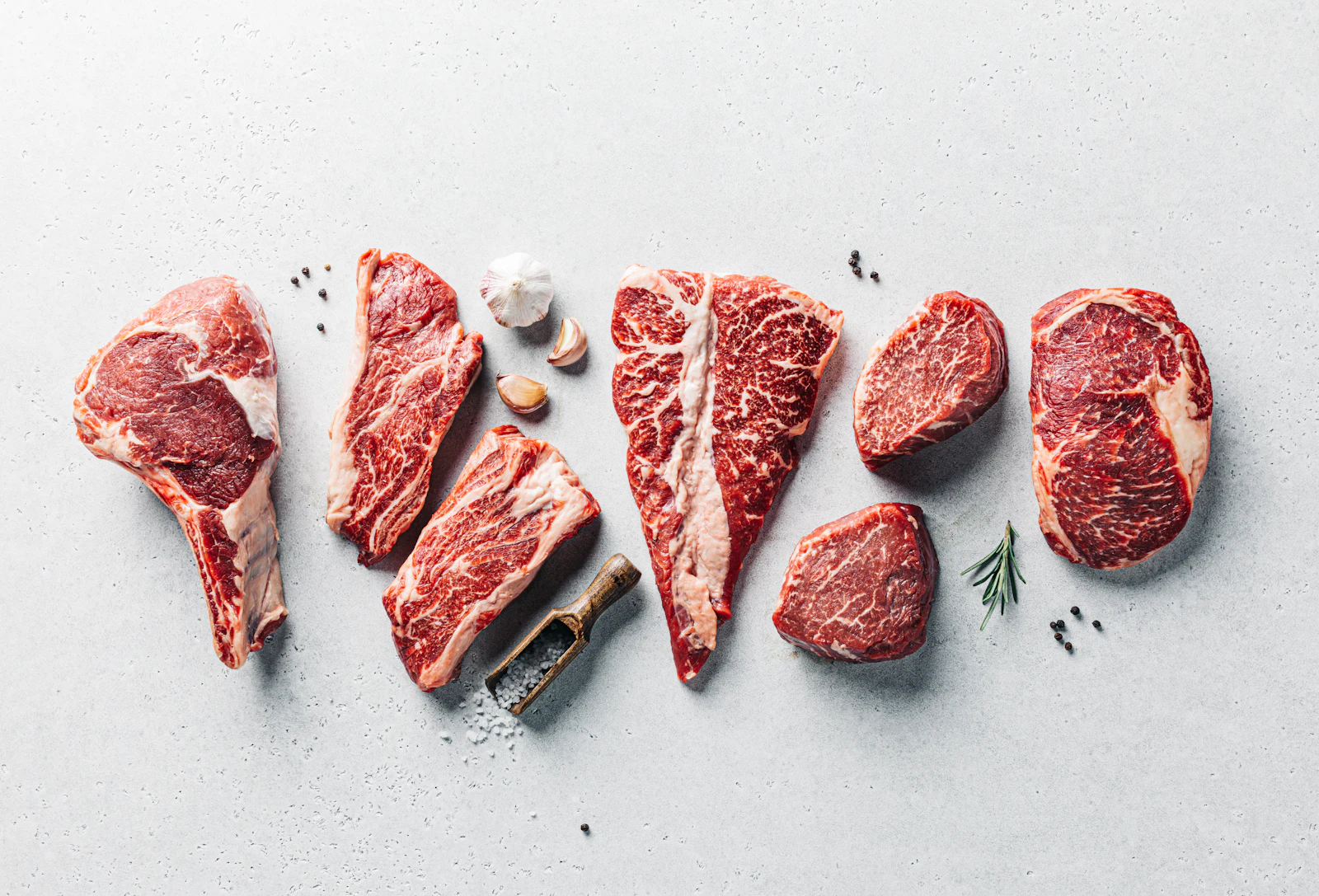
Brazilian plants export most beef as boneless cuts, vacuum-packed, boxed and frozen. The international trade uses English names, but spec sheets, labels and many conversations with Brazilian plants use Portuguese ones. Knowing both avoids mistakes in the quotation and on arrival. See the full list of cuts we quote.
Where Brazilian beef comes from
Most Brazilian cattle are Nelore, a zebu breed raised mainly on pasture in the Center-West and North of the country. Nelore beef tends to be lean, with a firm texture. Brazil's cutting system is also a little different from the Australian or American ones, so a cut with the same English name can be trimmed differently. Always confirm with the spec sheet.
Hindquarter cuts
| Trade name | Brazilian name | Notes |
|---|---|---|
| Striploin | Contra-filé | Steaks and food service |
| Tenderloin | Filé mignon | Premium cut, sold with or without the side strap |
| Rump cap | Picanha | The best known Brazilian cut, with its fat cap |
| Rump / top sirloin | Alcatra | Often split into smaller cuts |
| Topside | Coxão mole | Lean, versatile, popular in the Middle East |
| Silverside / outside flat | Coxão duro | Lean, for slow cooking and processing |
| Knuckle | Patinho | Lean, for dicing and mince |
| Tri-tip | Maminha | Part of the rump |
| Flank / bottom sirloin flap | Fraldinha | Grilling and food service |
Forequarter cuts
| Trade name | Brazilian name | Notes |
|---|---|---|
| Cube roll / ribeye | Ancho / entrecôte | Steaks, marbling varies |
| Chuck | Acém | Stewing, dicing and processing |
| Clod / shoulder | Paleta | Processing and slow cooking |
| Brisket | Peito | Slow cooking and processing |
| Shin & shank | Músculo | Soups and stews |
| Hump | Cupim | Typical of zebu cattle, prized in Brazilian barbecue |
Trimmings and offal
Trimmings are sold by lean content, such as 80/20 or 90/10 visual lean, mostly for processing. Offal, such as liver, tongue, tripe, heart and kidneys, has strong demand in Asia, the Middle East and Africa and travels under its own customs headings.
How the product is packed
- Each piece is vacuum-packed and placed in export cartons.
- Cartons carry labels with the cut name, weights, production and expiry dates, and the plant's SIF stamp.
- Frozen product travels at around −18 °C. A 40-foot reefer carries about 25 to 27 tonnes.
- For halal markets, labels and certificates follow the certifier's rules.
How to ask for cuts in a quotation
- Use the English trade name and the Brazilian name together, for example "striploin (contra-filé)".
- Give the share of each cut in the container, in tonnes or percentage.
- Say whether you accept mixed loads.
- State the packing, trim and shelf life you need.
- Ask for the spec sheet of each cut before you sign.
Our step-by-step import guide covers the rest of the specification, and you can request a quotation when you are ready.